The Postcolonial Age of Migration by Ranabir Samaddar
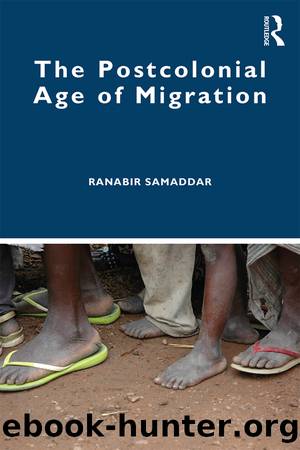
Author:Ranabir Samaddar [Samaddar, Ranabir]
Language: eng
Format: epub
Tags: Emigration & Immigration, Social Science, Refugees, History & Theory, Political Economy, Civil Rights, Political Science, Colonialism & Post-Colonialism, International Relations, Developing & Emerging Countries, Immigration, Political Process, Political Freedom, General, Demography, Public Policy, Social Policy, Geopolitics, Human Geography, Human Rights
ISBN: 9781000071405
Google: V7fjDwAAQBAJ
Amazon: B088JL2JH5
Goodreads: 54846090
Publisher: Taylor & Francis
Published: 2020-05-11T00:00:00+00:00
The migrant in the generalised context of conflict and civil war
To be fair to the army generals the military discourse springs not only from their minds, it has roots in the internal discourse of societyâs security also, on which the military discourse feeds. For instance, the Bodo student leader Upendra Brahma, an active member of Assam Agitation, pressed for implementation of Clause 10 of the Assam Accord, which said, âIt will be ensured that relevant laws for prevention of encroachment of government lands and lands in tribal belts and blocks are strictly enforced and unauthorised encroachers evicted as laid down under such lawsâ. Upendra Brahma demanded the eviction of the indigenous population from Tamalpur and the âimmigrantsâ from the char areas of Brahmaputra. This was certainly the signal for attacks on the Santhal population (not considered as âtribeâ in Assam) in Bodo areas. Similarly, the insistence on making Assamese virtually the language of instruction in all parts of the state became a matter of contention with the All Assam Tribal Students Union. The Karbi Autonomous Council Demand Committee complained that the leaders of Assam were taking steps to wipe out other distinct languages and cultures from the state. Specialists started saying that security could be provided now only by deployment of the army. With it began the full-scale security discourse and âsecuritisationâ of the social mind. Hereafter tea garden owners could feel secure now that the army was there; the people bought security now that they were paying taxes to government and the rebels both; and men of property had bought security with private guards and militias.
This is the backdrop of a generalised war, which includes struggles and rebellions of the last sixty to seventy years, when oneâs security becomes anotherâs insecurity. In this contentious history, politics of security may be described as the meeting point, the hinge, or one may say the moment of articulation, of the political problem of power and the historical question of race. The genealogy of racism and the construction of physical boundaries when natives will take guard against aliens begin with the historical discourse against migrants and outsiders, the discourse on all âotherâ groups and races, and the mutual narratives of plains and the hills, the settled peasants and the indigenous. In this historical transformation of the discourse on the alien we have the reappearance of the political discourse of war, of race struggle that traverses the field of power, leads to conflicts, decides who is an alien and therefore an enemy to be killed or to be expelled, and generates domination, rebellion, and more important, hatred that will prolong this war.
The large, looming, ill-defined, and confusing figure of the âimmigrantâ, in which various images such as the Muslim peasant from Mymensingh who had arrived in Assam in the first two decades of the last century, the Santhal peasant and tea garden labourer in Assam, the Nepali milkman, the immigrant worker in Dimapur, the Kuki in the Naga/Manipur Hills, the Hindu Bengali settler in
Download
This site does not store any files on its server. We only index and link to content provided by other sites. Please contact the content providers to delete copyright contents if any and email us, we'll remove relevant links or contents immediately.
Cecilia; Or, Memoirs of an Heiress — Volume 1 by Fanny Burney(32561)
The Great Music City by Andrea Baker(32021)
Cecilia; Or, Memoirs of an Heiress — Volume 2 by Fanny Burney(31958)
Cecilia; Or, Memoirs of an Heiress — Volume 3 by Fanny Burney(31944)
We're Going to Need More Wine by Gabrielle Union(19050)
All the Missing Girls by Megan Miranda(16038)
Pimp by Iceberg Slim(14515)
For the Love of Europe by Rick Steves(14149)
Bombshells: Glamour Girls of a Lifetime by Sullivan Steve(14078)
Talking to Strangers by Malcolm Gladwell(13375)
Norse Mythology by Gaiman Neil(13372)
Fifty Shades Freed by E L James(13245)
Mindhunter: Inside the FBI's Elite Serial Crime Unit by John E. Douglas & Mark Olshaker(9346)
Crazy Rich Asians by Kevin Kwan(9295)
The Lost Art of Listening by Michael P. Nichols(7507)
Enlightenment Now: The Case for Reason, Science, Humanism, and Progress by Steven Pinker(7315)
The Four Agreements by Don Miguel Ruiz(6767)
Bad Blood by John Carreyrou(6625)
Weapons of Math Destruction by Cathy O'Neil(6283)
